

What Is ISF Filing? (And How to Avoid a $5,000 Penalty)
For ocean importers: the 10+2 data elements, the 24-hour deadline that trips people up, and what CBP actually does when an ISF is late or wrong.
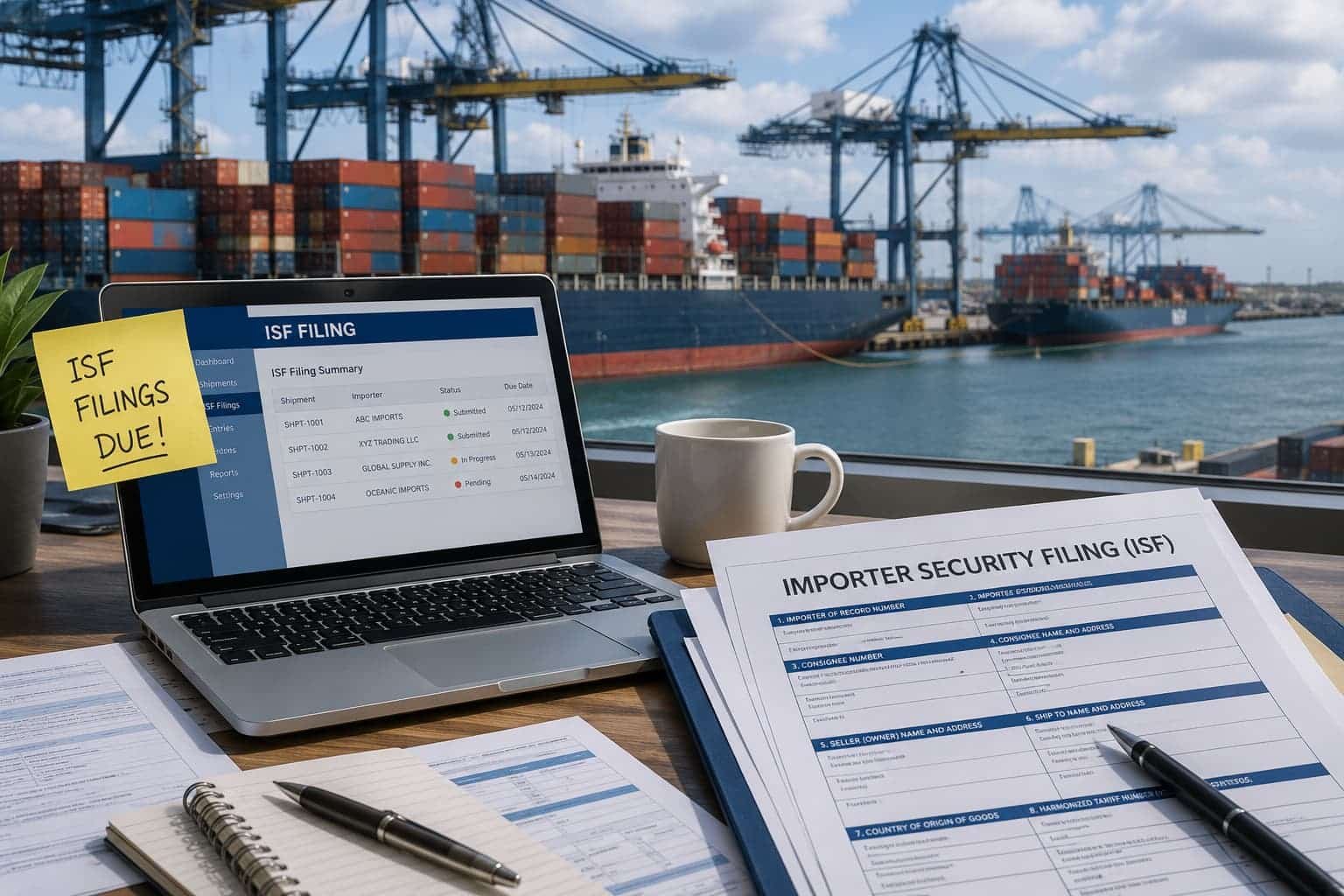
ISF filing, or the Importer Security Filing, is a mandatory CBP submission for ocean cargo bound for the United States. Eight of its ten importer data elements are due at least 24 hours before cargo is loaded at the foreign port. Late, inaccurate, or missing filings can bring $5,000 in liquidated damages per violation.
Key takeaways
- ISF (Importer Security Filing) is required for ocean cargo arriving in the United States. It is also called 10+2: ten data elements from the importer and two from the carrier.
- Eight importer elements are due at least 24 hours before loading at the foreign port. Container stuffing location and consolidator are due no later than 24 hours before U.S. arrival.
- A late, inaccurate, or incomplete ISF can bring $5,000 in liquidated damages per violation, with up to $10,000 per filing, plus holds and exams.
- A complete failure to file can lead to a Do Not Load message, a refusal to unload, withheld release, or seizure.
- The importer carries legal responsibility even when a broker or forwarder files, and filing requires an ISF or continuous customs bond.
If you're importing ocean freight into the United States, there's a filing you must submit before your cargo is even loaded overseas. Most importers know ISF filing exists. Far fewer understand what happens when it's wrong. A single error on a single shipment can bring a $5,000 claim and put your account under closer scrutiny, which means more exams, slower clearance, and higher costs on the shipments that follow.
What is ISF filing?
ISF filing is the Importer Security Filing, a mandatory U.S. Customs and Border Protection requirement for goods arriving in the United States by ocean vessel. It is called 10+2 because it requires ten data elements from the importer and two from the ocean carrier, submitted before the cargo is loaded at the foreign port.
The requirement comes from the SAFE Port Act of 2006, and the ISF rule took effect on January 26, 2009, with enforcement phased in over the following years. The goal is security: CBP wants to know who is shipping what, from where, and to whom before the cargo leaves the foreign port. That gives it time to assess risk and target inspections without slowing the whole port. It is not optional, and it is not a formality.
When does ISF have to be filed?
Most ISF data must be filed at least 24 hours before cargo is loaded on the vessel at the foreign port, not 24 hours before departure or U.S. arrival. Two elements, the container stuffing location and consolidator, may follow later but no later than 24 hours before the vessel arrives in the United States.
The timing rules come from 19 CFR 149.2:
| Data | Deadline |
|---|---|
| Seller, buyer, importer of record number, consignee number | At least 24 hours before loading at the foreign port |
| Manufacturer (or supplier), ship-to party, country of origin, HTS number | At least 24 hours before loading at the foreign port |
| Container stuffing location and consolidator (stuffer) | As early as possible, no later than 24 hours before U.S. arrival |
| Updates to any element | As soon as better information is known, before arrival |
| Five-element ISF for FROB, IE, and T&E cargo | Before loading at the foreign port |
That timing is why late filing is the most common source of ISF penalties. If your forwarder or broker waits for every shipping document before filing, it may already be late. "Late" can mean missing the window by a few hours on a Friday afternoon while the factory is loading containers.
Source: 19 CFR 149.2; U.S. Customs and Border Protection (2026)
What information goes into ISF 10+2?
An ISF includes ten importer data elements: seller, buyer, importer of record number, consignee number, manufacturer or supplier, ship-to party, country of origin, HTS number, container stuffing location, and consolidator. The ocean carrier separately files the other two: the vessel stow plan and container status messages.
| Element | What it is | Common error |
|---|---|---|
| 1. Seller | The party selling the goods to the buyer | Listing the shipper instead of the seller |
| 2. Buyer | The party buying the goods | Mismatches with the commercial invoice |
| 3. Importer of record number | The IRS or CBP-assigned number of the importer | Wrong or unregistered number |
| 4. Consignee number | The number of the party the goods are delivered to | Using the IOR number when they differ |
| 5. Manufacturer (or supplier) | The factory that makes or assembles the goods | Listing a trading company instead of the factory |
| 6. Ship-to party | The first U.S. location that receives the goods | Using a head office address |
| 7. Country of origin | Where the goods were made | Using the country of shipment |
| 8. Commodity HTS number | At least the first six digits of the HTS code | A code that doesn't match the entry |
| 9. Container stuffing location | Where the container was loaded | Left blank past the arrival deadline |
| 10. Consolidator (stuffer) | The party that loaded or arranged loading | Left blank past the arrival deadline |
Each field has to be accurate, not approximately accurate. CBP cross-references ISF data against entry summaries, commercial invoices, and bills of lading. A wrong manufacturer address, an HTS code that doesn't match the container, or a vague commodity description invites scrutiny. For help with the HTS field, see how to read an HTS code.
What happens if your ISF is late, wrong, or missing?
A late, inaccurate, or incomplete ISF can bring $5,000 in liquidated damages per violation, with total exposure of up to $10,000 per filing. A complete failure to file can also lead CBP to stop the cargo from loading, refuse unloading, withhold release, or seize the goods. Repeat problems raise exam rates on future shipments.
| Violation | Consequence |
|---|---|
| Late ISF | $5,000 in liquidated damages |
| Inaccurate or incomplete ISF | $5,000 in liquidated damages |
| Maximum per ISF filing | $10,000 |
| Failure to file | Liquidated damages plus possible Do Not Load, withheld release, general order, or seizure |
| Typical mitigated first violation | About $1,000 to $2,000 in CBP guidelines |
For a failure to file, CBP's options include a Do Not Load message to the carrier at the foreign port, withholding permission to unload, withholding release so goods go to general order storage, and seizure, according to Portside Customs Service's summary of the penalty guidelines. CBP's mitigation guidelines in CBP Decision 09-26 allow a first violation to be cancelled for a payment of about $1,000 to $2,000 when mitigating factors apply.
The claim is often the smaller problem. CBP can also withhold release or require intensive exams when an ISF is late or missing, and violations are tracked, which makes repeat cases worse, according to Great Lakes Customs Law. Exams add days, storage fees accrue while cargo waits, and a late delivery can stop a production line or break a customer commitment, costs that can dwarf the $5,000 claim.
Who is responsible for filing ISF?
The ISF Importer, usually the importer of record, is legally responsible for ISF compliance. Most importers delegate the actual filing to a licensed customs broker or freight forwarder, but delegating the work does not transfer the responsibility. If the filing is late or wrong, the claim falls on the importer.
Your provider files on your behalf, but only with the data you and your suppliers give it. If a supplier sends the wrong factory address, or a trading company hides the factory location, that bad data ends up in your ISF. CBP considers how you obtained information and whether you could verify it, but the importer still answers for accuracy. Filing also requires an ISF bond or a continuous customs bond. See what a customs broker does for the wider picture.
How do you make sure your ISF is always filed correctly? 6 steps
To file ISFs correctly every time, confirm who files and that your bond is in place, collect party data when you place the order, verify HTS codes before the first shipment, build the deadline into supplier timelines, file and then update before arrival, and match the bill of lading number exactly.
There are six steps to reliable ISF filing:
- Confirm who files and your bond. Decide whether your broker or forwarder files as your agent, and confirm you have an ISF or continuous bond in place.
- Collect party data at the purchase order. Get the actual factory name and address, seller, buyer, and ship-to details when you place the order, not when goods are ready.
- Verify HTS codes before the first shipment. Make sure the six-digit code on the ISF will match the classification on your entry.
- Build the deadline into supplier timelines. Require suppliers to confirm loading dates and send data at least 72 hours before loading.
- File, then update. File the required elements before the 24-hour cutoff, then update stuffing location, consolidator, and any changed details before arrival.
- Match the bill of lading. Confirm the ISF references the correct house or master bill of lading number so CBP can match it to the carrier's manifest.
The single biggest improvement is working with an integrated freight forwarder and customs broker. When one team books your freight and files your ISF, it already has the factory data, container details, and HTS codes, so there are no gaps between vendors. For why carrier-side capacity also matters, see NVOCC vs freight forwarder.
What is the difference between ISF and a customs entry?
The ISF is a security filing made before cargo is loaded overseas, while the customs entry clears the goods and sets the duties owed after they arrive. Both are required for ocean imports, they are filed at different times, and their data must line up, because CBP compares them.
| Factor | ISF | Customs entry |
|---|---|---|
| Purpose | Security screening before loading | Clearing goods and paying duties |
| Timing | Before loading at the foreign port | Within 15 days of arrival; can be prepared before arrival |
| Modes | Ocean only | All modes |
| Key data | Parties, origin, HTS-6, stuffing details | Full HTS code, value, origin, duties |
Air shipments don't need an ISF. They use CBP's Air Cargo Advance Screening program instead. See ocean vs air freight from Asia for how customs differs by mode.
How does Beyond Logix handle ISF filing?
Beyond Logix handles ISF filing in-house under the same roof as freight forwarding. Because our team books your ocean freight, it already has the manufacturer data, container details, and HTS codes needed for an accurate ISF, and we notify clients at each ISF milestone so there's no guesswork about whether a shipment is covered.
ISF is one piece of import compliance. It works alongside customs entries, duty payments, HTS classification, trade agreement documentation, and Section 301 compliance. Our customs brokerage team handles ISF filings, customs entries, duty drawback claims, bond renewals, and consultations, with one team and one point of accountability.
Frequently asked questions
What does ISF stand for in shipping?
ISF stands for Importer Security Filing. It is also called 10+2, because it requires ten data elements from the importer and two from the ocean carrier. It is mandatory for ocean cargo arriving in the United States and gives CBP time to assess security risk before cargo is loaded overseas.
Who has to file an ISF?
The ISF Importer, usually the importer of record, is responsible for the filing. Most importers authorize a licensed customs broker or freight forwarder to transmit it through CBP's systems, but legal responsibility stays with the importer. Filing also requires an ISF bond or a continuous customs bond.
What is the deadline for ISF filing?
Eight importer data elements must be filed at least 24 hours before cargo is loaded on the vessel at the foreign port. The container stuffing location and consolidator can follow, but no later than 24 hours before arrival in a U.S. port. The clock is tied to loading overseas, not departure or arrival.
How much is the penalty for a late or wrong ISF?
CBP can assess $5,000 in liquidated damages per violation for a late, inaccurate, or incomplete ISF, with total exposure of up to $10,000 per filing. Each shipment is a separate violation. Mitigation petitions can reduce first violations, but repeat problems also raise exam rates on future shipments.
Can my freight forwarder file ISF for me?
Yes, if it is authorized as your agent and has access to CBP's filing systems, which licensed customs brokers and many NVOCCs do. Confirm before your first shipment who files, how they get your supplier data, and how they confirm each submission, because the legal responsibility stays with you.
What happens if my ISF has incorrect information?
CBP can assess $5,000 in liquidated damages for an inaccurate or incomplete ISF, the same as for a late one. Inaccurate data can also trigger holds and exams. CBP considers how you obtained the data and whether you could verify it, so correct errors with an update as soon as you find them.
Does ISF apply to air freight?
No. ISF applies only to ocean cargo arriving in the United States. Air freight has its own advance security filing under CBP's Air Cargo Advance Screening program, which works differently and is filed on a much shorter timeline because flights are so fast.
What is the difference between ISF and a customs entry?
The ISF is a security filing made before cargo is loaded overseas. The customs entry clears the goods and establishes duties, and it must be filed within 15 days of arrival, although brokers often prepare it before the vessel arrives. Both are required for ocean imports, and their data must match.
Conclusion: file early, file accurately
ISF filing is simple in concept and unforgiving in practice. Most data is due 24 hours before loading overseas, every field must be accurate, and a mistake can cost $5,000 per violation plus holds and exams. Collect supplier data early, verify HTS codes, and work with a team that books freight and files ISFs together.
Talk to our customs team about making ISF a non-issue on every shipment.
Sources
- 19 CFR 149.2, Electronic Code of Federal Regulations
- Importer Security Filing Penalty Guidelines, Portside Customs Service
- CBP Decision 09-26, U.S. Customs and Border Protection
- Importer Security Filing (ISF) Penalty Mitigation, Great Lakes Customs Law